EDM Resources
My favorite gold explorer/developer

The Following article is not investment advice, just my own thoughts on EDM Resources
I believe EDM’s Gays River deposit has been very misunderstood, and potentially has massive hidden value in the form of gold, which has gone comically undetected for several decades, until last year when EDM Resources announced a high grade gold discovery on September 3rd. In this article I will detail my reasoning for why I believe there could be a significant gold resource, potentially ready to mine by Q3 2026, as the former “zinc-lead” mine goes back into production.
Straight to the Chase
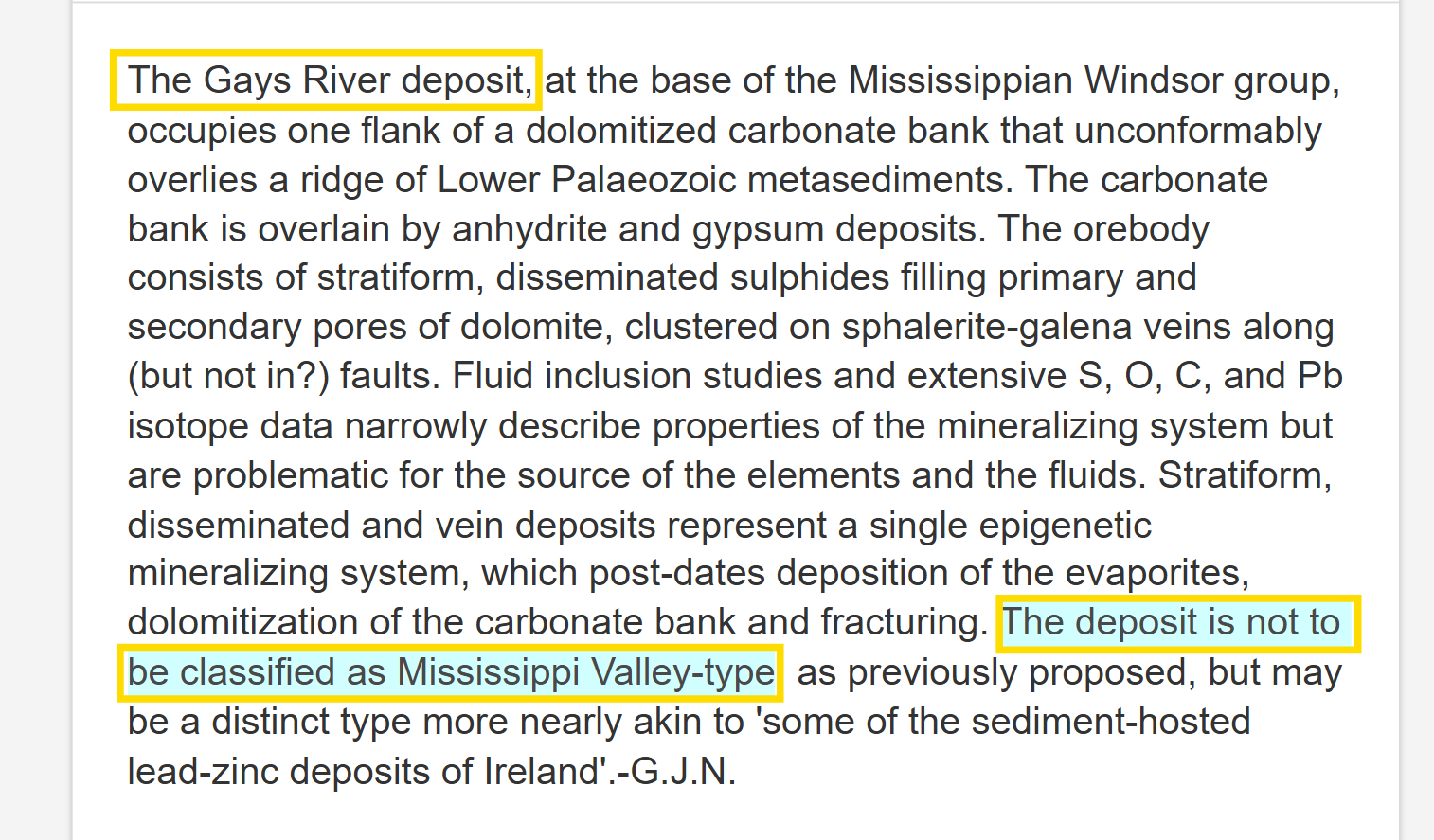
EDM’s Gays River deposit has been labelled and treated as a zinc-lead MVT (Mississippi Valley Type) deposit since it was first discovered and developed in the 1970s by ESSO, a large Canadian resource company. MVT deposits are known to not contain gold, as their formation temps are too low to dissolve gold from the earth’s crust during fluid mineralization, and thus, no one every assayed the drill cores for gold. But here is the catch, several geologist have stated that the Gays River deposit is not to be classified as MVT!
Check out this study from 1984 which I found on ResearchGate, it compares the deposit to Irish type zinc-lead deposits that are much hotter:
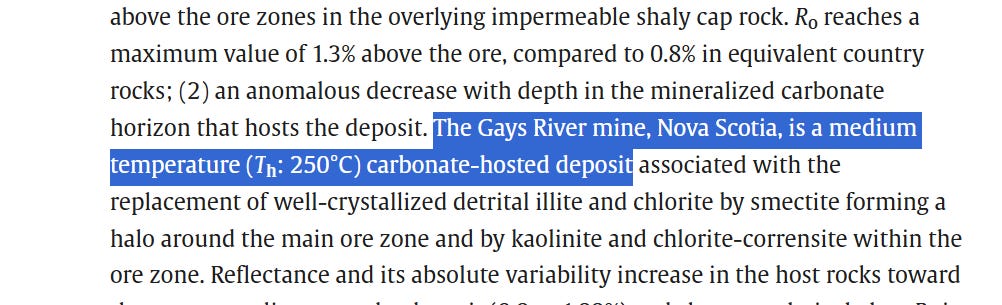
And this study from 1996, also stating the higher temperatures:
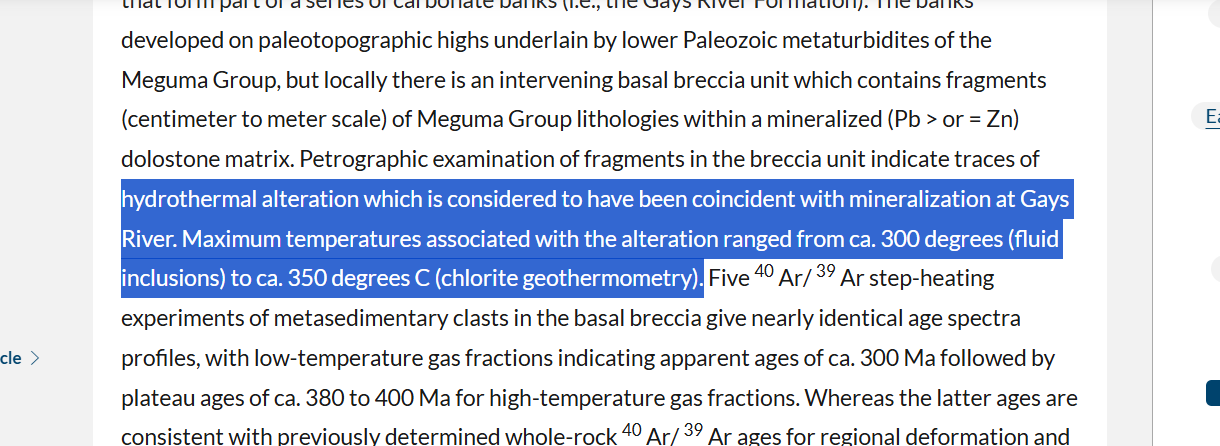
And then there is this study from GeoScienceWorld, 1994, purporting even higher temperatures up to 350c! Way way hotter than MVTs, and solidly in the category of Polymetalic CRD deposits, which are easily able to mobilize gold.
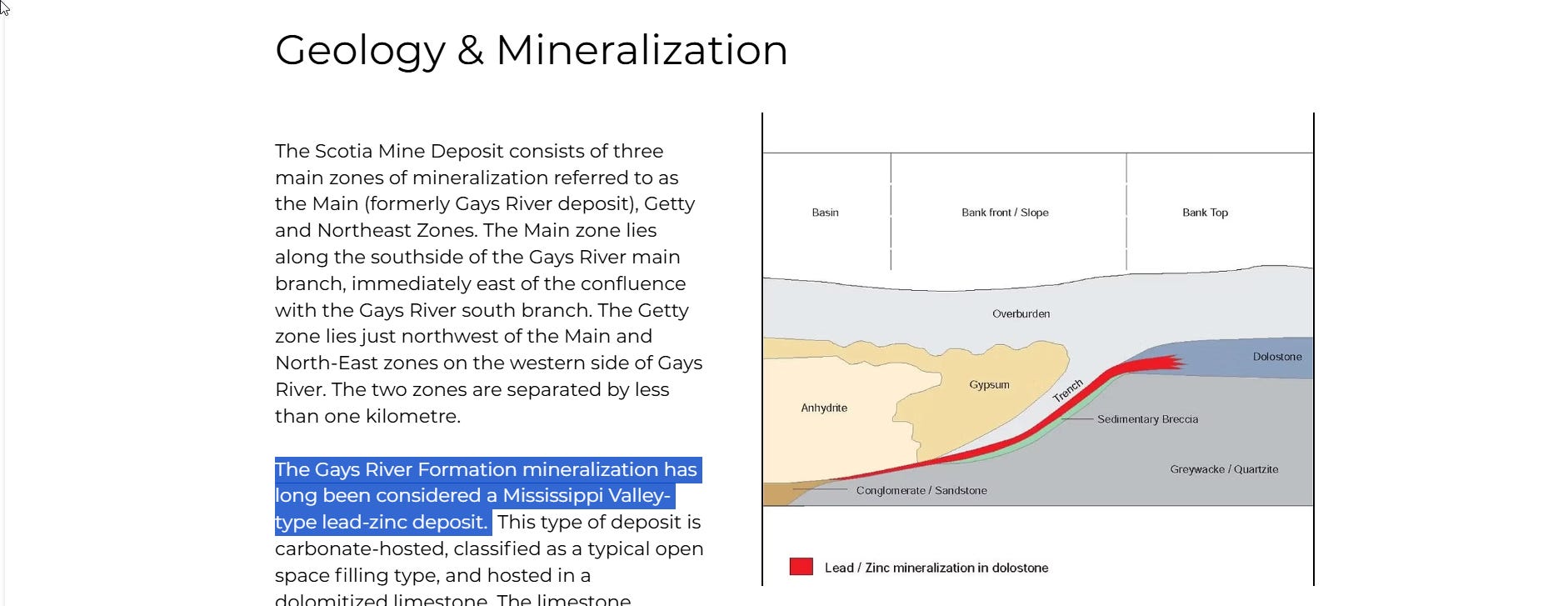
However, the deposit has always been treated like a typical low temp MVT, and EDM Resources confirms it, despite themselves admitting the deposit formed under higher temperatures than usual in the 2021 ni 43-101:
Due to this MVT categorization, the Gays River deposit was never assayed for gold, and focus remained exclusively on zinc, lead, and gypsum. Over the years the mine changed hands several times, eventually ending up in the ownership of EDM Resource’s. However, last year, EDM Resources announced “game changing” high grade gold assays from concentrate piles left over from when the mine shut down in 2009 due to the financial crisis. The market was unphased. check out the assays:
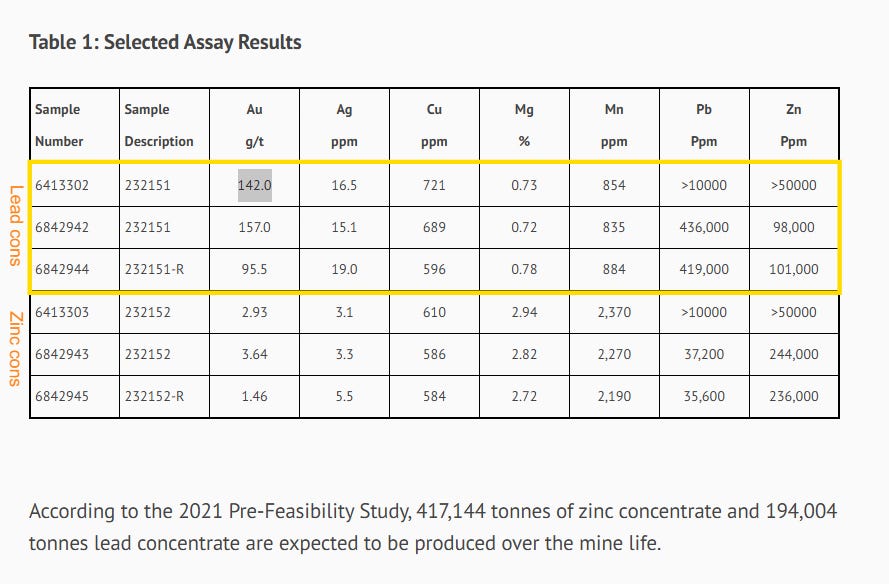
I did a lot of digging on where the ore came from to make these consentrates, and how much raw ore was used to produce the lead pile, which is 2.9m3 in size, and I discovered that these concentrates were almost certainly made from the upper benches of the deposit during ore clean up in 2009. The answer came from the scozinc.com’s operation history

This discovery was really startling for me, because the upper benches are near the top of the pit, about 100m above their entrance from the Meguma anticline below, which serves as the control, or port, for the mineralized fluids to enter the carbonate windsor group rocks. This is very important! Because the gold didn’t just teleport up to the upper portion of the mine, but rather, it is highly probable that the gold mineralization is continuous throughout, maybe wherever there is galena (lead) and sphalerite (zinc). Actually, as I understand the gold is almost certainly locked up within the galena (primarily) and the sphalerite.
Galena itself forms a larger molecule like structure called a lattice, and at higher temperatures gold can substitute the lead, thus creating a gold mineralized galena, the gold itself being invisble to the naked eye. This is what the grades above suggest, especially since there is also gold in the zinc. If the gold was free in the form of grains or nuggets, it would likely have partition to the lead completely, since their densities are similar, but seeing as there is lead inside the zinc concentrates (as per the assays) then that galena is what I think allows for the gold grades in the zinc concentrate too.
How much ore made the concentrates?
We know that the gold came from the upper benches and was considered low grade (.47% lead in historical reports), and the lead concentrate pile was 2.9m3, which would weigh about 11 tons. The recovery rate for lead at scotia mine was 89%, knowing these numbers we can back calculate that it took 1800-2000 tons of raw ore to create the lead pile and zinc piles that remained left over from 2009.
Implied Raw Ore Gold Grades
Using the gold grades from the concentrates table above, and knowing the weights of the concentrate piles (roughly 11 tons for lead, 74 tons for the zinc), we can calculate that there are roughly 1779gram of gold between both concentrate piles.
Now, lets take the total gold weight and divide it by the tonnage of ore used to produce the cons and we get 1779g/2000 tons = 0.89g/t Au in the raw low grade ore.
0.89g/t Au is very reasonable and typical for low grade bulk tonnage deposits.
Total Speculated Gold Resource
The 2021 Pre-Feasibility Study for the Scotia Mine outlines probable reserves of 13.66 million tonnes at 2.03% Zn and 1.10% Pb, with projected life-of-mine concentrate production of 417,144 tonnes of zinc concentrate (at 57% Zn) and 194,004 tonnes of lead concentrate (at 71% Pb).
Using our back-calculation methodology (assuming the assayed concentrate gold grades from the upper bench material apply across the entire deposit, with gold primarily partitioning to the lead concentrate and minor to zinc, and 100% gold recovery to concentrates for a minimum contained estimate), the total contained gold in the resource is estimated as follows:
Gold in lead concentrate: 194,004 tonnes × 142 g/t Au = 27,548,568 grams Au
Gold in zinc concentrate: 417,144 tonnes × 2.93 g/t Au = 1,222,232 grams Au
Total speculated gold: 28,770,800 grams Au ≈ 925,000 troy ounces Au in probable reserves.
But is the Gold Mineralization Resource-wide?
Now, is it reasonable to assume that this gold mineralization continues broadly throughout the system? Yes. Let me show you why:
The key quote describing the mineralization as a single continuous event comes from the abstract of the 1984 paper by Akande and Zentilli: “Stratiform, disseminated and vein deposits represent a single epigenetic mineralizing system, which post-dates deposition of the evaporites, dolomitization of the carbonate bank and fracturing.”
This is further supported by the paragenesis section (p. 1198-1200), which outlines a unified ore-stage process involving the influx of hydrothermal metal-rich saline brines, with fluid inclusion data showing consistent homogenization temperatures (mean 215°C for sphalerite, ranging 205–219°C) and salinities (~20.4 wt% eq. NaCl), indicating fluid homogeneity and a continuous trapping event without boiling or multiple pulses.
This single-system interpretation aligns with my view on gold mineralization being more uniform and consistent across the deposit. The epigenetic hydrothermal nature, with hot brines (215°C mean, not 250°C as noted—though peak values approach 220°C) interacting extensively with the porous carbonate bank and basement faults, would promote broad fluid mixing and dissemination. Evidence from the paper includes widespread dolomitization, vein extensions into the basement, and isotopic uniformity (e.g., consistent δ³⁴S values across sulfides), all pointing to pervasive fluid flow rather than localized pulses. Given the bulk tonnage style (13.66 Mt reserves, disseminated and stratiform ores), gold—if tied to the same event as Zn-Pb—should indeed be broadly spread in low but consistent grades, enhancing byproduct potential.
Additional Strongly Acidic fluids Supports Gold Transport
Another point that is not typical for regular MVTs but is ideal for gold transport and is indeed present at scotia mine is the evidence for strongly acidic brines. Typically MVT deposits are slightly-moderately acidic, and neutralize upon contact with the carbonate host rock, but the Gays River deposit evidences stronger than normal acid levels which are evident in studies that descibe a pronounced halo 5km wide around the deposit. This infers Ph levels < 5, ideal for mobilizing gold!
Significant Number of Gold Occurences Around and on Gays River
On top of all the above evidence highlighting geological conditions favourable for gold, Nova scotia has one of the greatest densities of gold occurances in Canada, and even rivals other regions globally.

Below is another perspective showing EDM’s mines proximity to the famous historical Oldham Gold District, only 15km south of the Gays River deposit, as well as the gays river gold placer gold occurrence a couple km away from scotia mine. There are many more historical mines and districts within a 25-50km radius from the Gays River deposit. This is yet one more great piece of evidence that the basement rock which spewed up the Gays River deposit fluids are fertile grounds for significant gold.
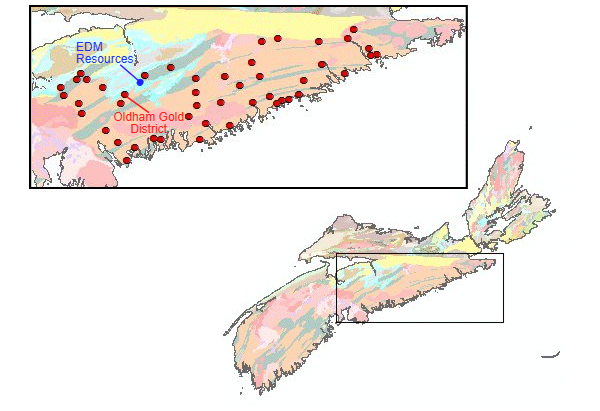
These past mines were predominately high grade bonanza gold mines, often between 1-3oz/ton, sometimes higher, like at some Oldham gold veins: “The area (Oldham) was mined from 1862-1946 and produced a total of 85,178 ounces of gold. One lot of quartz extracted in 1864 had a phenomenal yield of 103 ounces of gold per ton. To put that in perspective, successful historical Nova Scotia gold mines often had just one or two ounces of gold per ton.” source In total over 1 million high grade ounces were mined by the old timers in the 1800s, which is very impressive considerring they were cherry picking the easy stuff with “primitive” tools
So what do I Expect from EDM Resources?
I am anticipating that there will be meaningful amounts amounts of gold in this deposit, based on what I have read and shared in this post. I would be very happy with 10,000oz/year in gold credits, and would not be totally shocked to see even up to 60k oz/year if the gold correlation I simulated above proves true and they have 925k oz in their probable reserves of 14Mt. But, even if they have no gold at all, which is already proven false since the mine was producing at a surprises rate of 66k/year on the day they shut it down, then I am still playing this for the zinc-lead industrial metals, since just on those metals alone I think the stock should be 10x higher, not to mention a zinc bull market as zinc is in the process of breaking out.
Basically, EDM is a very derisked ultra fast gold explorer. They already have all the drill cores from the original drilling in their drill shack, and technically, they can just resubmit those and reassay them for gold. If they gold is there, they will update the resource estimate this year, as they stated in there January press release:
“Exploration & Resource Upside
• Commencement of gold exploration activities at the Scotia Mine targeting near-term value enhancement.
• Potential update of the 2021 NI 43-101 Mineral Resources Estimate to include additional mineral resources, subject to technical review.”
No matter what they prove, even a small amount will add great upside value at todays gold prices, but the potential stock gains that could be here if they find that the mineralization is evenly throughout the system like I believe it is, are off the charts. We could be looking at a 1bn CAD Mcap once in production (this fall?)
With the current ultra low market cap, this is a bet I am delighted to make, and I am positioned for it.
Lastly, the deposit has another 16Mt of ore in the inferred category, which could double the mine life. If the gold proves to be dispered throughout, then that ore could also eventually be included in the probable category and double the mine life (maybe double the gold resource as well?)
2025 DMS Study Improves Extraction
Don’t forget to consider the 2025 DMS and how it improves lead and zinc extraction notably. This will also improve the the ‘21 NPV, makin todays undervaluation even greater!
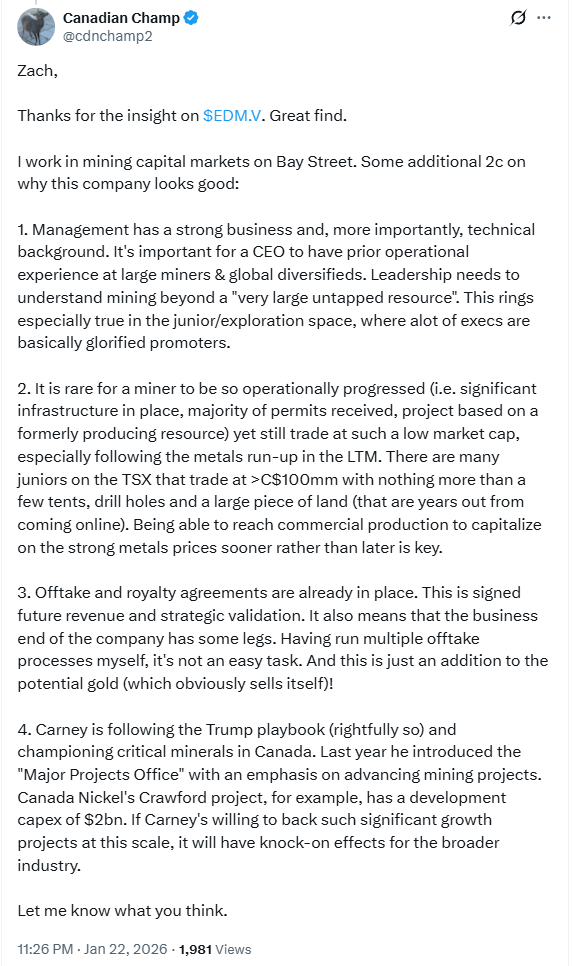
Additional Notes From Canadian Champ
I wanted to include these thoughtful notes from Canadian Champ on X as I think he did a great job highlighting some additional positive aspects of the project, especially regarding management, which I am very pleased with:
How I Discovered EDM Resources
Except for some very quite forums, EDM had basically no following at all: no no views on YouTube videos, no views on X news releases, the company was left for dead back in the commodity bear market of 2022, and it was never rediscovered.
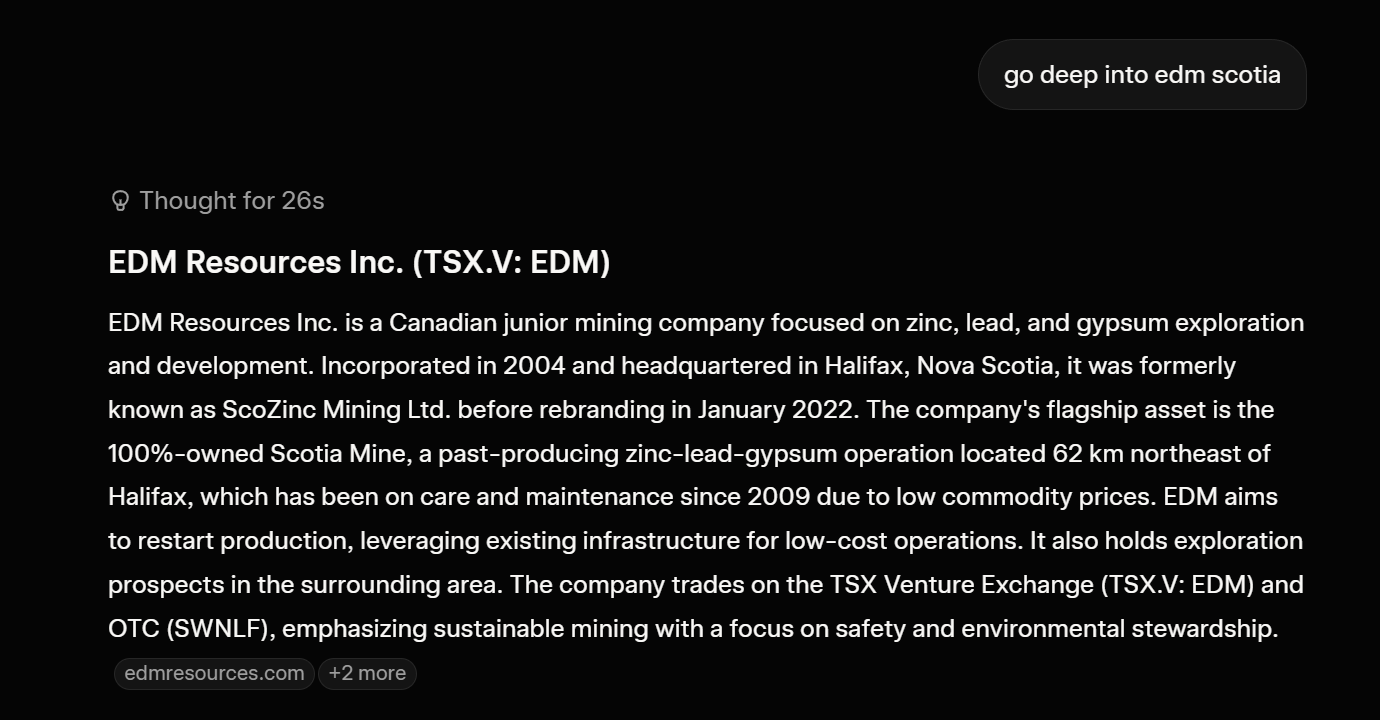
I discovered EDM Resources 2 weeks ago when I asked Grok to make me up a list of the top 10 worst zinc companies, together with the top 10 cheapest zinc companies. I told him to list the reason(s) why each company was as cheap as it is. Most of them were garbage: no resource, failed exploration stories, endless dilution, the typical junior nightmare. Then came EDM Resources.
I skimmed over the story and reason for cheapness, it was listed in the top 10 cheapest zinc miners/explorers as a nano cap. The words “scotia mine” caught my eye, being from Nova Scotia myself. If it wasn’t for this detail I probably wouldn’t have given it enough attention to dig deeper. After reading through the rest of the list, I asked grok to give me a deeper summary of the 3 companies I thought had the most potential or interest to me, EDM being one of them.
Here are some screenshots from my Jan. 2, 2026 chat with grok:
I was interested, but what I saw next really caught my attention:
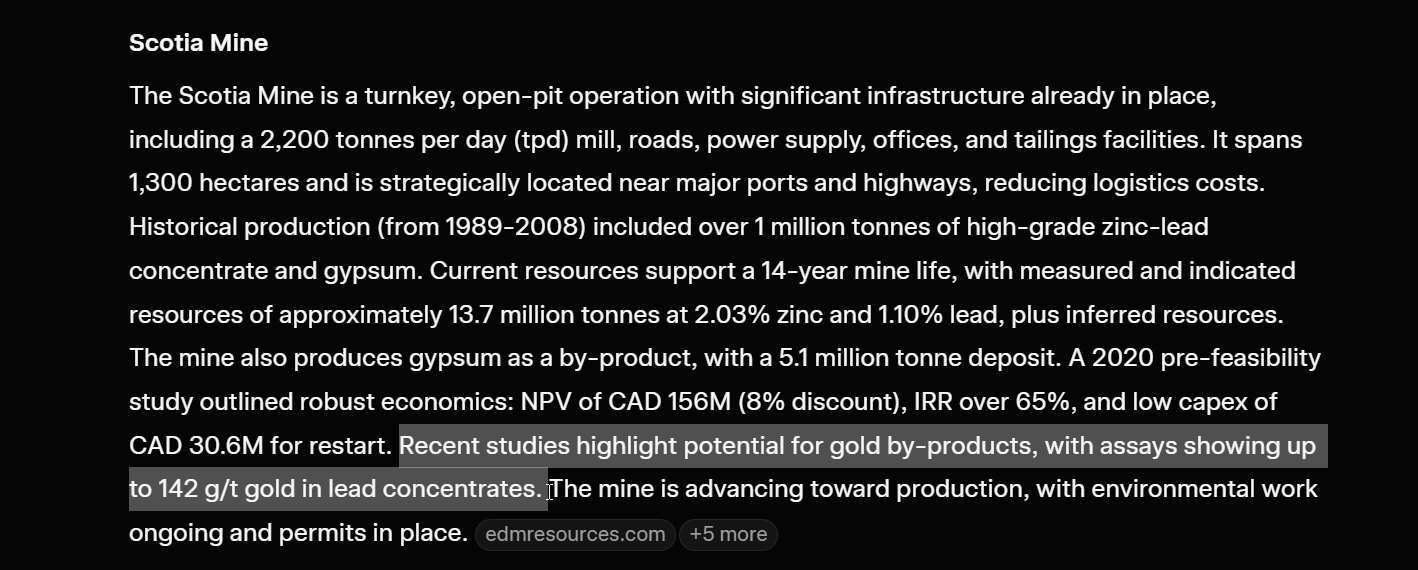
I started thinking about all the gold mines I had read about over the years from the prior three Nova Scotia gold rushes.

Zac - Great post and idea with EDM. What do we know about the usability of the mill? It sounds like it last operated in 2009. How do we know it hasn’t rusted out over the last ~15 years? Stated differently: While I’m sure there is some value in the existing infrastructure of the mill, are there any data points or information that gives you confidence the mill is anything close to operational? How do we know it’s not going to take $50-$100M in fresh capital to get the mill operational again?
Just found a link on http://ceo.com to this company. I’ve asked a P.Geo friend to look at it… I was surprised he wasn’t aware of it, or the area—maybe he was.
I know it’s running, but your report laid it out quite well. Thanks.
I just tried a small order, but Fidelity still thinks it’s a foreign security and wanted $50 comm. I have quite a number of “F” stocks and have only been charged $50 for EULIF, which is AUS based. Maybe I’ll start a chat and whine….
I’m also in HG… wanted to double my 5.5k shares.. but have stood pat, when we were under $5 (USD) Why? Because I move too slow lots of times. My average is $3.57